Welcome to the Multiomics Workshop
Workshop 2, Module 0
Wi-Fi
Network: Golden_Tulip
Click on Conference
Password: Diamond254
Goals for this session
Get to know your instructors and neighbors
Set expectations for the week
Meet the study and the data we’ll work on all week
Get excited!
Nairobi, 9 to 13 November 2026
Golden Tulip Westlands
61 of us, from 12 countries
Meet the team
Please stand up and introduce yourselves:
- Instructors
- Teaching assistants
- Logistics and support
Everyone’s name and institution is on the team page.
Let’s make this workshop work for all
You belong here. This workshop is intended for a wide-audience with a focus on beginners. If you feel out of place - it’s our problem, not yours!
Stay committed. This week-long workshop is intended to build each day and leave you with skills you can really use. Commit to stay engaged for best results, for you and your group!
This is a challenging but friendly environment. We are here to learn and grow. In order to make the right environment please follow “the 4 social rules” and code-of-conduct.
The week
![]()
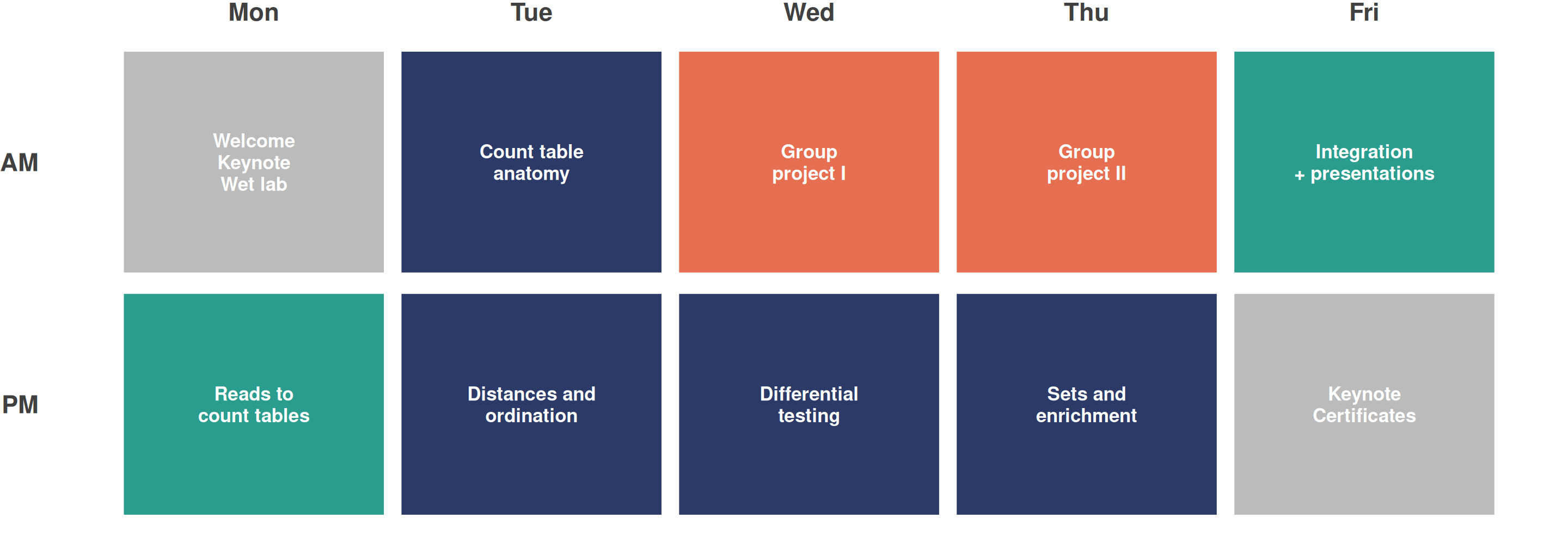
The navy blocks are the four coding modules and the orange blocks are group project time. Teal blocks are lectures.
Today
This morning
- Talk from Dr. Douglas Kwon, Ragon Institute
- Lindsay Droit on library prep
- Scott Handley on generating count tables from sequencing data
- Interactive activity
Lunch 12:30 to 1:30 pm
No computer activities today
We planned day one without any computer work on purpose, while we find out how the venue works for us.
Please finish the first getting started steps here in the room today:
- Create a GitHub account
- Create a Discord account
- Join the workshop Discord: discord.gg/9a9WcAUMR
Once you’ve joined, this is the workshop channel.
Both kinds of data arrive as a table of counts
![]()
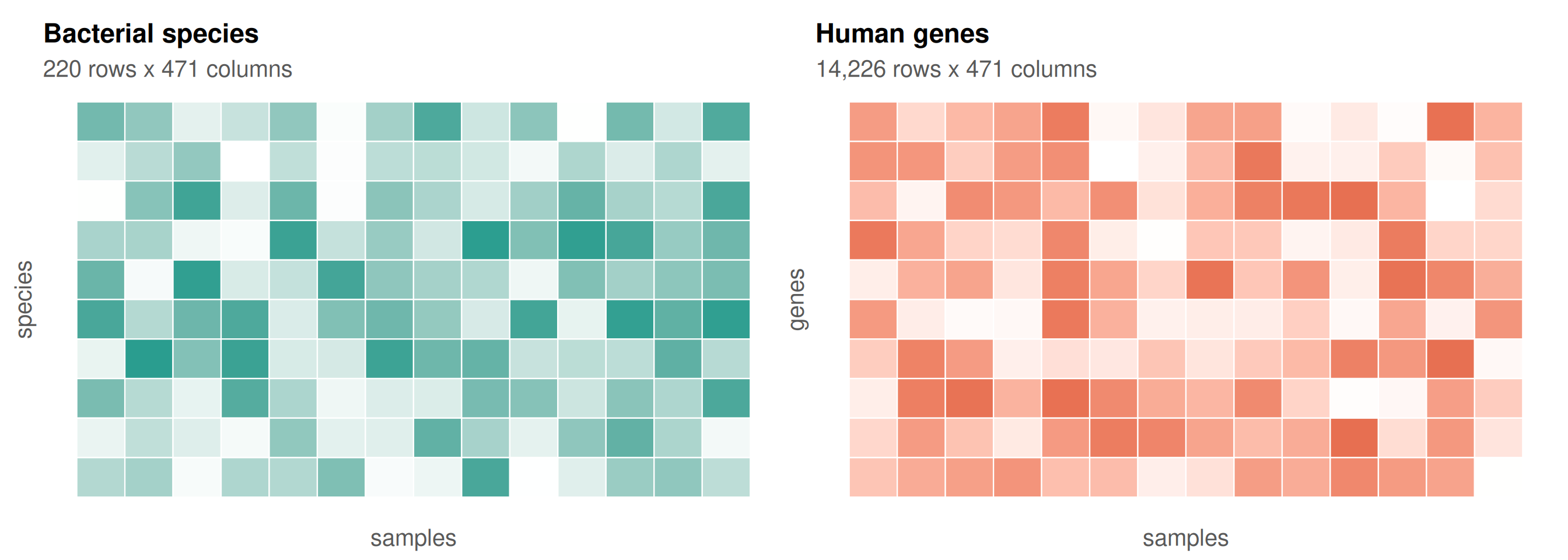
Each row is a feature, each column is a sample, and each cell counts the sequencing reads for that feature in that sample. Every method this week is taught on one table and practised on the other, with the same code.
The questions you will ask of both tables
| How much did we sequence? |
library size |
library size |
Tue AM |
| What is here at all? |
prevalence |
expression level |
Tue AM |
| How similar are two samples? |
beta diversity |
sample distance |
Tue PM |
| Which features differ between groups? |
differential abundance |
differential expression |
Wed PM |
| What do the hits have in common? |
taxonomy |
gene sets |
Thu PM |
The study we will work on
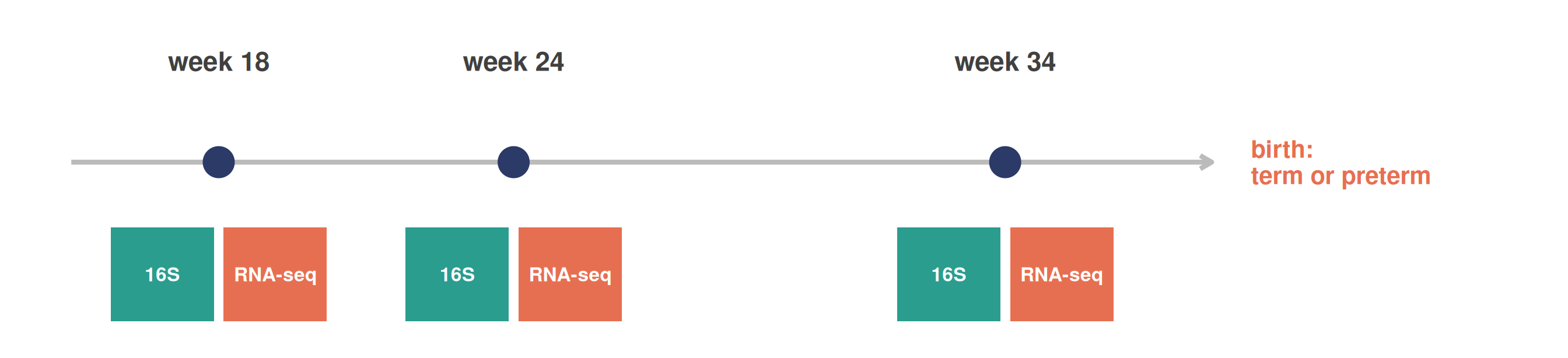
A pregnancy cohort of 157 participants, each sampled at weeks 18, 24 and 34.
- Every cervicovaginal sample was measured twice: bacterial 16S and human gene expression.
- Each participant has one outcome, term or preterm birth.
![]()
These data are constructed
Every count in both tables came from sequencing a real sample.
The study around those counts is ours. We made up the visit labels and the birth outcomes so the week has something worth finding.
Analyse the data as carefully as you would your own, and do not cite the result.
What you will learn this week
- Check a count table before trusting it: sequencing depth, prevalence, filtering
- Measure how similar samples are, and draw it as an ordination
- Test which species or genes differ between groups
- Find what the hits have in common: taxonomy and gene sets
- Put the species and gene tables together for the same samples
Each method is taught on one table and practised on the other.
Pi, your AI coding agent
Pi works in your Codespace. It reads your files, writes code, runs it and reads the output.
What we want you to practise with it:
- asking for an analysis clearly enough that Pi does what you meant
- reading the code it wrote and checking the result makes sense
- picking a model: a cheap one for routine work, a stronger one when it matters
Your API key has a $3 daily limit and expires about six months after the workshop.
Library prep
Lindsay Droit, Washington University School of Medicine
How a swab becomes a sequencing library, for 16S and for RNA-seq.
Open Lindsay’s slides
Each module is three and a half hours
That includes a 30-minute break.
The order changes from module to module. A common one is slides, an exercise, more slides, then a second exercise.
You will have an AI coding agent the whole time. Every exercise ends by asking you to check what it did.
Slides like this one explain an idea
A concept, a figure, or a few lines of code to read.
Most slides look like this.
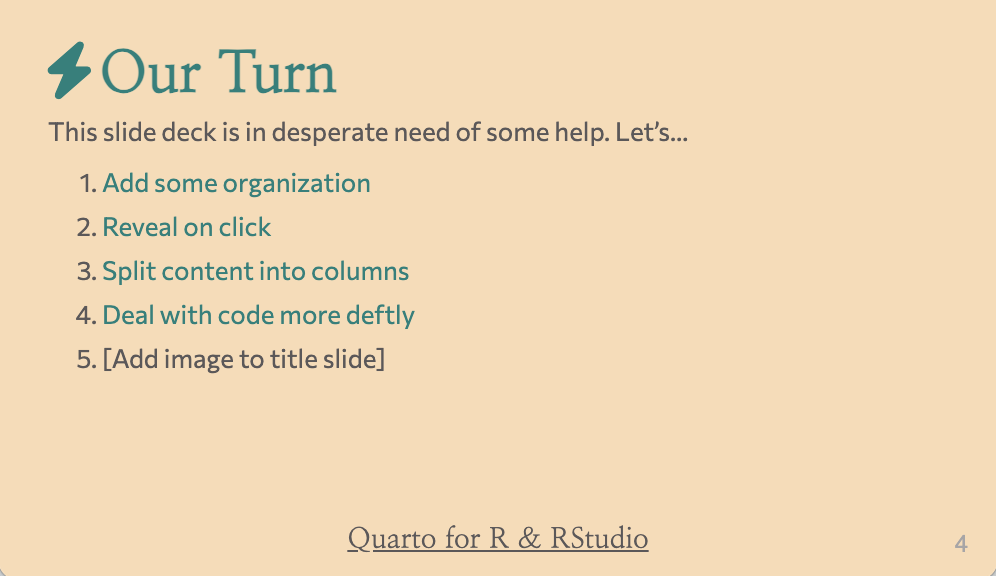
Our turn
We work live on the screen: a demonstration in the Codespace, or a worked example from start to finish.
Watch, or follow along on your own laptop.
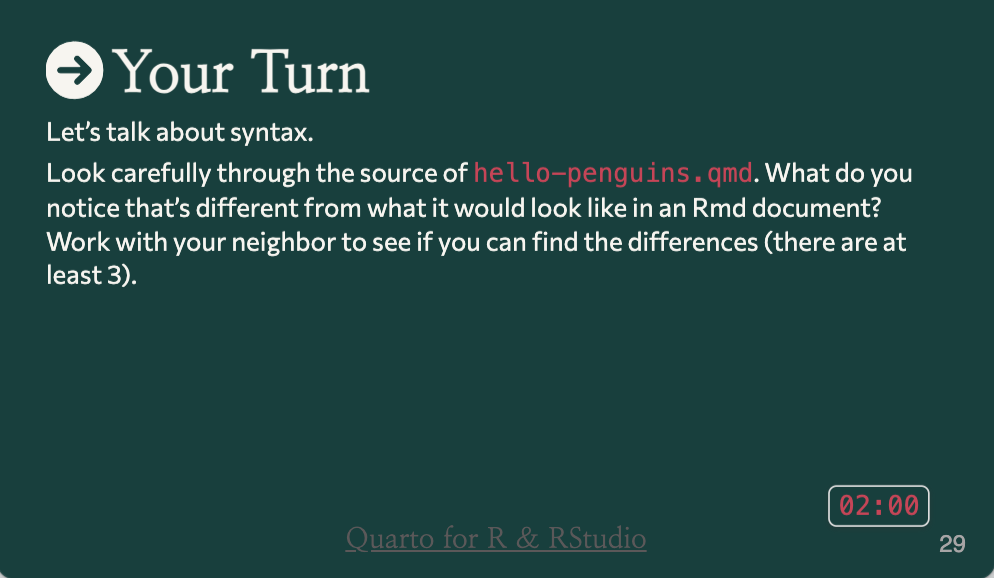
Your turn
You do something: an exercise, a poll on your phone, or a question to talk over with the people next to you.
Before Tuesday morning
- A GitHub account
- The workshop Codespace, opened once, so the container is built
library(tidyverse) running without error
Teaching assistants are in the room all day Monday. Bring setup problems to them then, not on Tuesday morning.
Next we hear from Dr. Douglas Kwon
Ragon Institute
What were you hoping for?